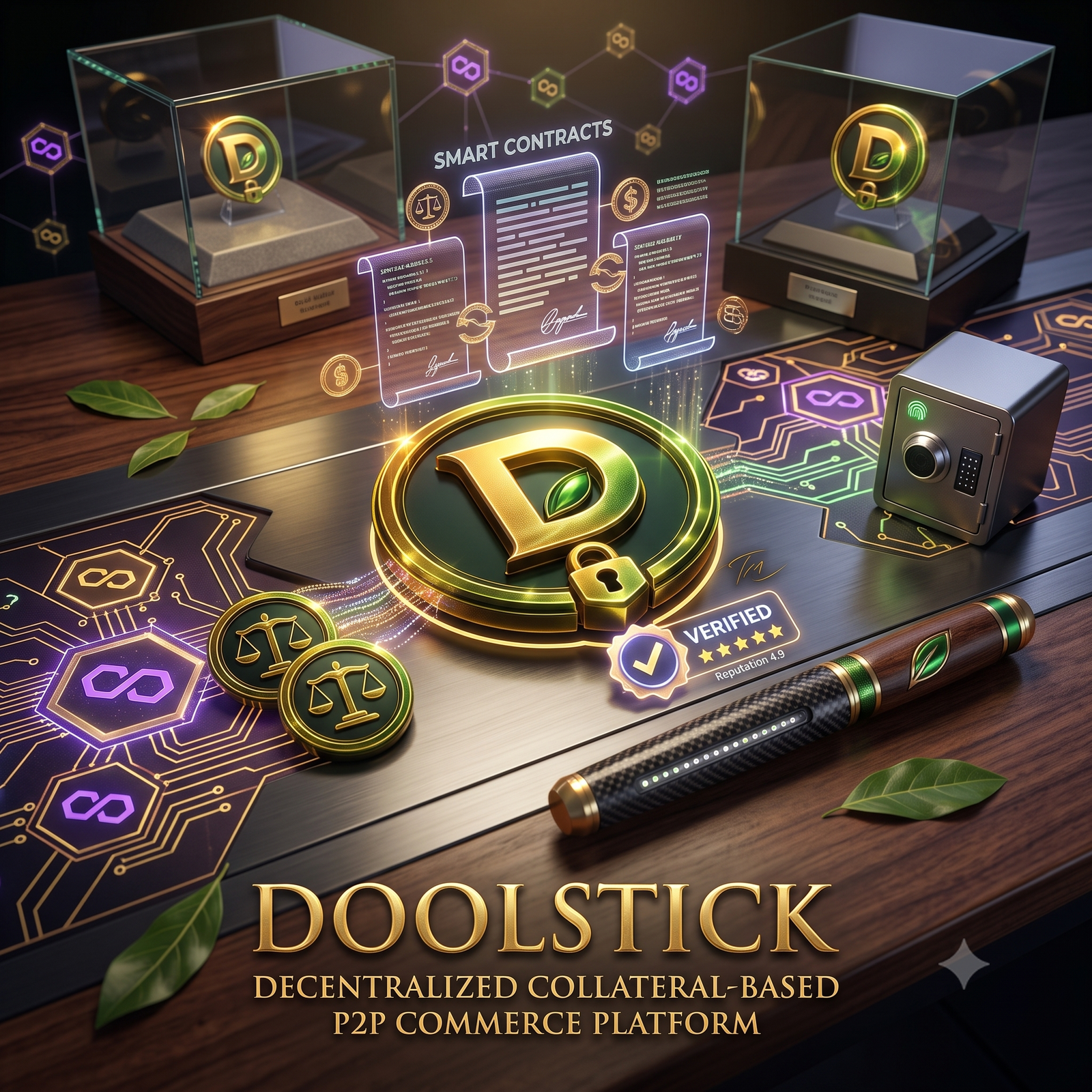
Doolstick is an early-stage Web3 platform designed to help two people conduct business without relying entirely on personal trust. Rather than operating as a conventional crypto exchange with an order book, Doolstick combines peer-to-peer trading, smart-contract escrow, collateral-based agreements, marketplace tools and blockchain-based reputation.
The platform’s central idea is that both parties should have something at stake. Funds and collateral can be governed by predefined contract rules, while completed transactions contribute to a persistent reputation record. Doolstick describes this combination as a way for strangers to transact more confidently online. Its current website includes dedicated areas for Safe Trade, Global Exchange, shops, transfers, active contracts, referrals and a “Reputation Suit.”
Doolstick remains extremely new. Its public Bitcointalk announcement appeared in late July 2026, and independently verifiable information about contract deployment, usage, audits, token distribution and team identity remains limited.
Doolstick at a Glance
| Category | Details |
|---|---|
| Platform | Doolstick |
| Platform type | P2P trading and smart-contract escrow |
| Main product | Safe Trade |
| Trading model | Direct agreements between users |
| Escrow model | Smart-contract-controlled funds and collateral |
| Blockchain | Polygon, according to project-supplied listing information |
| Ecosystem token | CRUT, according to project-supplied information |
| Other features | Global Exchange, shops, transfers, referrals and reputation |
| Public announcement | Late July 2026 |
| Accountable public team | Not clearly disclosed |
| Published security audit | None located during this review |
| Public source-code repository | Not located during this review |
| Development stage | Early-stage platform |
Some details above were supplied directly for Doolstick’s Chainquiry listing. Readers should verify the blockchain, token contract and current platform configuration through official project channels before committing funds.
What Is Doolstick?
Doolstick is best understood as a crypto escrow and peer-to-peer commerce platform, not simply as another token swap service.
A normal centralized exchange brings buyers and sellers into an order book and temporarily controls their account balances. Doolstick instead focuses on individual agreements between specific parties. These agreements may involve cryptocurrency, services, products, digital work or another transaction in which neither participant wants to move first.
This is a common problem in online trade:
- A buyer does not want to pay before receiving the agreed product.
- A seller does not want to deliver before receiving payment.
- Neither party necessarily knows or trusts the other.
- Traditional escrow services introduce an intermediary, additional fees and discretionary control.
Doolstick attempts to address this through smart-contract escrow, collateral and reputation. Its website presents the platform as a secure escrow-based system in which trust is built into the structure of each transaction rather than based only on promises between users.
How Doolstick Safe Trade Works
Safe Trade appears to be the platform’s core transaction system.
At a high level, the parties define an agreement and place the required funds or collateral under smart-contract rules. The contract then determines how assets can be released, returned or otherwise handled as the trade progresses.
The exact workflow may differ by transaction type, but a collateral-based trade usually involves the following process:
- One participant creates the proposed agreement.
- The second participant reviews and accepts its terms.
- The required payment and collateral are locked.
- The seller provides the agreed product or service.
- The buyer confirms completion.
- The smart contract distributes the locked assets according to the agreement.
The purpose of collateral is not merely to hold the buyer’s payment. It can also give both parties a financial reason to complete the trade honestly.
For example, a seller who has posted collateral risks losing more than the expected payment by failing to deliver. A dishonest buyer may similarly risk their own collateral by falsely claiming that the seller did not perform.
Academic work on dual-deposit escrow has shown how deposits from both parties can create incentives for cooperation when the trade conditions and digital product can be objectively verified.
Doolstick should publish a clearer technical explanation covering the exact collateral requirements, deadlines, cancellation conditions and release logic for each contract type. Those details are essential for users to understand the actual economic risk before accepting a trade.
Is Doolstick Completely Trustless?
“Trustless” is a useful blockchain term, but it can easily be overstated.
A smart contract can reliably verify on-chain events. It can confirm that tokens were deposited, that a deadline passed or that a particular wallet approved a release. It cannot independently determine whether a physical package arrived, whether freelance work met a client’s expectations or whether an off-chain service was completed properly.
That creates what is often called the oracle problem: the blockchain needs an external source of information about what happened outside the blockchain.
Research into blockchain commerce has argued that secure exchange of physical goods cannot be achieved solely through a smart contract without introducing some combination of trusted evidence, third-party intervention or exploitable economic behaviour.
Doolstick may reduce the amount of personal trust required, but users must still understand:
- Who decides when the parties disagree?
- What evidence can be submitted?
- Can an administrator intervene?
- Is dispute resolution automated or manual?
- Who controls any administrative contract privileges?
- Can decisions be appealed?
- What happens when both participants refuse to cooperate?
Until these mechanisms are documented in detail, Doolstick is more accurately described as a trust-minimised escrow platform than a system that eliminates trust in every possible transaction.
Doolstick’s Collateral Model
Collateral is one of Doolstick’s most distinctive ideas.
Traditional escrow normally locks only the buyer’s payment. A collateral-based structure can require additional value from one or both participants. That changes the incentives surrounding the transaction.
Suppose a buyer agrees to pay 100 USDC for a service. A Doolstick contract could theoretically require the buyer, seller or both parties to place additional collateral into the agreement. Each participant would then have more to lose by abandoning the deal or acting dishonestly.
This model may discourage casual fraud, but it also introduces practical questions:
- How is the collateral amount calculated?
- Is it a fixed percentage or selected by the users?
- Which assets can be used?
- Is collateral returned automatically after completion?
- What happens when the transaction value changes?
- Can one party intentionally keep the other party’s funds locked?
- Are there time limits for disputes?
- Who pays the network and platform fees?
The collateral system will be easier to evaluate when Doolstick publishes complete worked examples and verified smart-contract documentation.
Reputation Suit and Immutable Reputation
Doolstick also presents a feature called Reputation Suit and describes its reputation tokens as immutable. The apparent objective is to create a transaction history that cannot be casually deleted or rewritten after a user behaves dishonestly.
This could be useful because ordinary marketplace ratings are controlled by platform databases. A company can modify them, an account holder can abandon a bad profile and reviews may be removed.
An on-chain reputation mechanism could instead record signals such as:
- Successfully completed contracts
- Transaction value
- Disputes or cancellations
- Length of account activity
- Positive endorsements
- Penalties or contract violations
However, immutable reputation also creates difficult design questions.
A false or malicious rating could follow a wallet permanently. Users may create new wallets to escape poor histories. Reputation can also be bought, manipulated through coordinated transactions or accumulated through many low-value trades before a larger scam.
Doolstick’s public documentation should explain whether reputation tokens are transferable, whether they use a soulbound-token model, who is authorised to issue them and how incorrect reputation records can be challenged.
Global Exchange
Doolstick includes a Global Exchange section, which places the platform partly within the crypto-exchange category.
It does not currently appear to resemble a conventional centralized exchange such as Binance or Kraken. Doolstick’s broader design points toward negotiated peer-to-peer agreements rather than anonymous orders automatically matched through an order book.
Potential use cases could include:
- Direct token-for-token trades
- Crypto purchases negotiated between individual users
- OTC-style transactions
- Trades involving assets not listed on major exchanges
- Cross-border agreements settled through cryptocurrency
The important distinction is that Doolstick is not merely providing price discovery. It is attempting to combine exchange functionality with collateral, escrow and reputation.
Users should still verify which assets are supported, how exchange rates are determined, whether liquidity is guaranteed and whether any administrator can suspend or alter a transaction.
Shops and Web3 Commerce
Doolstick’s website also includes dedicated areas for shops, shop settings and listing creation. These sections suggest that merchants may be able to create storefronts and sell through the same escrow infrastructure.
Integrating shops with Safe Trade could allow merchants to attach contract terms, collateral and reputation directly to their listings. A buyer would then evaluate not only the product but also the seller’s transaction history.
This may be more useful than a standalone escrow tool because the entire process can occur inside one ecosystem:
- Discover a product or service.
- Review the merchant’s reputation.
- Agree on the contract conditions.
- Deposit payment and collateral.
- Complete the trade.
- Record the outcome.
The practical value of this marketplace will depend on whether Doolstick can attract real merchants and buyers. At present, independently verified data on active shops, completed contracts and transaction volume has not been published.
CRUT Token
Project-supplied listing information identifies CRUT as Doolstick’s ecosystem token and Polygon as its blockchain network. The website also contains a dedicated Buy Tokens section.
The reviewed public pages did not expose enough information to independently verify:
- The official CRUT contract address
- Maximum and circulating supply
- Token allocation
- Team or treasury holdings
- Vesting schedules
- Initial sale price
- Liquidity arrangements
- Token taxes
- Administrative privileges
- Whether the token contract is upgradeable
- Whether liquidity is locked
- The precise utility of CRUT in Safe Trade
These are not minor details. A token should not be purchased based only on its ticker or name, particularly because fraudulent contracts can copy legitimate branding.
Doolstick should prominently publish the verified Polygon contract address and link directly to the corresponding block-explorer page. Users should never rely on a contract address posted by an unaffiliated account or received through a private message.
Why Use Polygon?
Operating on Polygon can make escrow contracts more practical by offering EVM-compatible smart contracts and generally lower transaction costs than Ethereum mainnet.
Lower fees matter when a transaction requires several separate actions, such as:
- Approving a token
- Depositing payment
- Depositing collateral
- Updating the contract
- Releasing funds
- Returning collateral
The trade-off is that Polygon introduces its own network, bridge, wallet and smart-contract risks. Users must also ensure that they are using the correct token version and network when depositing funds.
Because Doolstick can potentially control valuable escrowed assets, the quality of its smart contracts matters far more than the cost of the network on which they run.
Referrals, Teams and Platform Governance
Doolstick includes referral functionality, Team Admin tools and a President Dashboard.
These features suggest that the ecosystem may include organisational roles, referral incentives or a layered governance structure. The public information reviewed by Chainquiry does not yet explain:
- How a president is selected
- What authority the position carries
- Whether governance is on-chain
- Whether CRUT holders can vote
- How teams are formed
- What referral rewards are paid
- Whether referral incentives are funded by platform fees or token emissions
- Whether administrators can alter escrow contracts
Doolstick should clarify the distinction between platform administration and decentralised governance. A smart contract can hold funds while still giving its owner significant control through privileged functions.
Security and Smart-Contract Transparency
Security is the most important unresolved issue for Doolstick.
Escrow contracts are direct targets because they are designed to hold funds belonging to multiple users. A vulnerability could potentially affect every active agreement rather than a single wallet.
During this review, Chainquiry did not locate:
- A published independent smart-contract audit
- A public GitHub repository
- Verified contract source code
- A bug-bounty programme
- A formal security policy
- Documentation of administrative keys
- Multisignature information
- Emergency pause procedures
- A complete list of deployed contracts
That does not prove that the platform is insecure. It means users currently lack the evidence required to independently assess its security.
Before handling significant transaction values, Doolstick should publish verified contracts, describe all privileged functions and commission an audit from a recognised independent security firm.
Team and Legal Transparency
The public pages reviewed by Chainquiry do not clearly identify Doolstick’s founders, developers, registered company, operating jurisdiction or responsible legal entity.
Anonymous teams are not automatically fraudulent, but anonymity matters more when a platform:
- Promotes a token
- Operates a marketplace
- Provides dispute resolution
- Controls upgrade or administrative keys
- Holds funds through contracts
- Collects platform fees
Users should know who is responsible when the website becomes unavailable, a contract fails or a disputed transaction requires intervention.
Clear terms of service, privacy disclosures, prohibited-use policies and jurisdictional information would substantially improve Doolstick’s credibility.
What Doolstick Does Well
Doolstick has a more concrete product concept than many early token projects. Its current strengths include:
- A clear focus on peer-to-peer commerce
- Escrow-based transaction infrastructure
- Collateral intended to align incentives
- Persistent blockchain reputation
- Marketplace and shop functionality
- Direct exchange tools
- Active-contract management
- A wider ecosystem rather than a token-only landing page
The combination of collateral and reputation is particularly interesting. Collateral addresses the immediate transaction, while reputation is intended to influence a user’s ability to find future counterparties.
Main Risks and Limitations
Doolstick’s principal risks currently include:
Early operating history: The platform only became publicly visible in July 2026.
Limited documentation: Important contract, token and dispute-resolution details remain unclear.
No published audit located: There is no publicly inspectable independent security report.
Team anonymity: The responsible developers and legal entity are not clearly disclosed.
Unverified tokenomics: CRUT supply, allocation, vesting and contract privileges need greater transparency.
Off-chain enforcement limitations: Smart contracts cannot independently determine whether physical goods or subjective services were delivered correctly.
Administrative uncertainty: The powers associated with Team Admin and the President Dashboard are not documented clearly.
Limited adoption evidence: Public figures for completed contracts, users, shops and volume are not available.
Reputation manipulation: On-chain reputation can still be farmed, purchased or abandoned through new wallets.
Final Assessment
Doolstick is attempting to solve a genuine problem: how can two strangers conduct business online when neither wants to trust the other first?
Its proposed answer combines smart-contract escrow, collateral, peer-to-peer exchange, merchant shops and immutable reputation. That makes Doolstick broader than a basic escrow dApp and more specialised than a conventional crypto exchange.
The concept has merit. Requiring participants to place value at risk can discourage dishonest behaviour, while persistent reputation may help reliable users build credibility over time.
The platform is not yet transparent enough to treat those ideas as proven infrastructure. Its contracts, administrative permissions, token economics, dispute process, audit history and accountable team require much fuller disclosure.
Doolstick is therefore best viewed as an experimental P2P escrow and commerce platform. It may be worth following as its contracts and user base develop, but users should begin with small amounts, verify every contract address and avoid locking funds they cannot afford to lose.
Frequently Asked Questions
What is Doolstick?
Doolstick is a Web3 platform for peer-to-peer business agreements. It combines crypto escrow, collateral, marketplace tools and blockchain-based reputation.
Is Doolstick a crypto exchange?
Doolstick includes a Global Exchange, but it is not primarily a conventional order-book exchange. It is better classified as a P2P exchange and smart-contract escrow platform.
What is Safe Trade?
Safe Trade is Doolstick’s escrow-focused transaction system. It is intended to let two parties establish an agreement and place funds or collateral under predefined contract conditions.
What is the Doolstick token?
Project-supplied information identifies CRUT as the ecosystem token. Users should obtain its official Polygon contract address directly from verified Doolstick sources before purchasing it.
Is Doolstick completely trustless?
Not in every situation. Smart contracts can enforce on-chain payments and collateral, but they cannot independently verify subjective services or delivery of physical goods.
Has Doolstick been audited?
Chainquiry did not locate a publicly available independent smart-contract audit during this review.
Is the Doolstick team public?
The reviewed website pages do not clearly identify named founders, developers or an accountable legal company.
DoolStick is now listed on Chainquiry!