What Is Aetheris (AETH)? Inside the Hybrid Scrypt PoW/PoS Blockchain
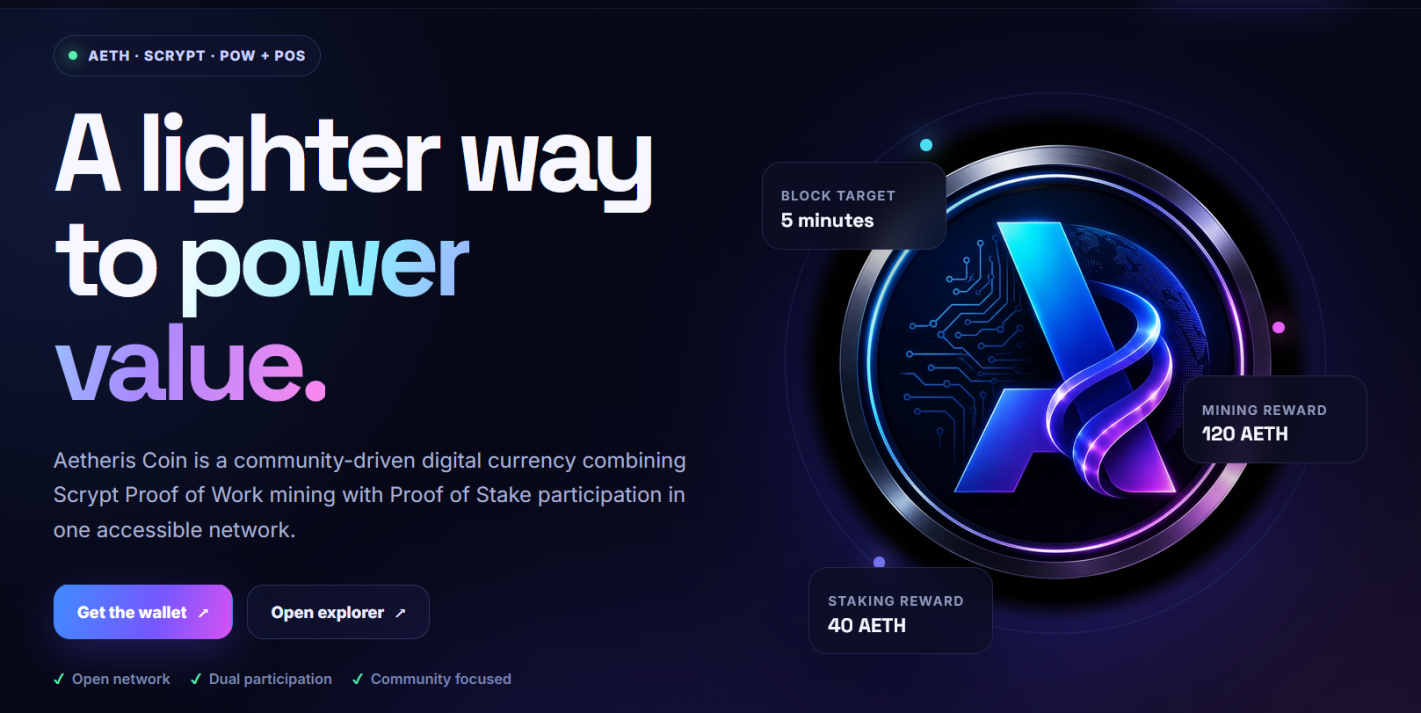
Aetheris is an independent Layer 1 cryptocurrency built around a familiar idea: allow miners and coin holders to participate in securing the same blockchain. Its native asset, AETH, can be earned through Scrypt-based Proof of Work mining and Proof of Stake rewards, creating a hybrid network rather than relying exclusively on one consensus method.
The project is aimed primarily at miners, stakers, full-node operators, and users interested in traditional peer-to-peer digital currencies. It is not currently presented as an Ethereum-compatible smart-contract platform, DeFi network, or high-throughput application chain. Instead, Aetheris is focused on operating as a mineable and stakeable digital currency with dedicated wallets, its own blockchain, and community-run infrastructure.
Aetheris at a Glance
| Category | Details |
|---|---|
| Project | Aetheris |
| Native coin | AETH |
| Network type | Independent Layer 1 blockchain |
| Consensus | Hybrid Proof of Work and Proof of Stake |
| Mining algorithm | Scrypt |
| Proof of Work reward | 120 AETH per block |
| Proof of Stake reward | 40 AETH per block |
| Target block time | 5 minutes |
| Difficulty adjustment target | 10 minutes |
| Minimum staking age | 8 hours |
| Maximum staking age | Unlimited |
| Proof of Work end | Block 7,000,000 |
| Recommended confirmations | 6 |
| Coinbase maturity | 10 blocks, plus the default confirmation |
| Development allocation | 15% of staking rewards, according to the whitepaper |
| Maximum supply | Not publicly specified |
| Source-code licence | MIT |
| Smart contracts | Not documented |
| Public team | Not disclosed |
The protocol parameters above come primarily from the Aetheris whitepaper, source code, and official announcement. Some important economic details—including a maximum supply, circulating supply, allocation table, and complete emission schedule—have not been publicly documented.
What Is Aetheris?
Aetheris is a native cryptocurrency network rather than a token issued through Ethereum, BNB Chain, Solana, or another existing blockchain. Users interact with it through Aetheris-specific wallet software, addresses, nodes, and mining infrastructure.
The project describes AETH as a decentralised digital asset intended to support inexpensive peer-to-peer transactions while giving participants two ways to help secure the chain. Miners contribute computing power through Scrypt Proof of Work, while holders can keep eligible coins in an online wallet to participate in Proof of Stake.
Aetheris traces its genesis block to December 17, 2025, based on the timestamp embedded in its publicly available source code. Its main English-language Bitcointalk announcement followed on January 2, 2026, introducing the project as a new hybrid Scrypt cryptocurrency.
This makes Aetheris a relatively young network. Its current proposition is consequently narrower than that of mature application-focused blockchains: provide a functioning cryptocurrency, distribute coins through mining and staking, and build a community around Scrypt-based participation.
How Aetheris Uses Hybrid Consensus
The defining feature of Aetheris is its combination of Proof of Work and Proof of Stake.
Scrypt Proof of Work
Aetheris miners compete to produce valid blocks using the Scrypt hashing algorithm. A successful Proof of Work block currently carries a base reward of 120 AETH.
Scrypt is especially familiar within the altcoin-mining community. For Aetheris, using it creates a potential entry point for miners who already understand Scrypt software, pools, difficulty settings, and specialised mining equipment.
The protocol permits Proof of Work until block 7,000,000. At the stated five-minute block target, reaching that height would theoretically take around 66 years from genesis if blocks continue close to their target interval. The precise date will depend on actual network conditions, but this parameter suggests that Proof of Work is intended to remain part of Aetheris for decades rather than disappear in the near future.
Once the network passes block 7,000,000, the published design says that Aetheris will rely exclusively on Proof of Stake.
Proof of Stake
AETH holders can also participate in block creation through staking. Coins must remain in the wallet for at least eight hours before becoming eligible, while the project lists no maximum stake age.
A successful Proof of Stake block produces 40 AETH. The whitepaper also states that 15% of staking rewards is allocated to a development or donation fund intended to support continued development and marketing. The source code identifies a development-fund address, although the public documentation does not provide a detailed treasury policy, spending reports, or a community-governance process for that fund.
Staking helps broaden participation beyond miners, but its security depends on the actual distribution of AETH. A highly concentrated supply could result in concentrated staking influence. Aetheris has not yet published enough supply-distribution data to independently assess that risk.
Why Combine Mining and Staking?
A hybrid model can potentially draw security from two separate participant groups. Miners must commit hardware and electricity, while stakers must hold coins and keep their wallets participating in the network.
For Aetheris, this also serves as a distribution mechanism. New AETH enters circulation through both mining and staking instead of being distributed solely through a token sale or a fixed allocation to early investors.
That does not automatically guarantee fair distribution. Evaluating fairness would require reliable data covering the genesis allocation, early mining activity, address concentration, staking participation, and current circulating supply. Those figures are not included in the project’s published whitepaper.
Network Architecture and Transaction Processing
Aetheris is built from an older, established cryptocurrency code base. Its GitHub documentation states that the software builds on Bitcoin Core 0.13.2, supplemented by patches from newer versions. The project is released under the MIT licence, allowing developers to inspect, modify, and redistribute the code.
Its principal network settings include:
- A five-minute target between blocks
- Difficulty adjustment targeting a ten-minute timespan
- Six confirmations for transactions
- Ten-block maturity for newly generated coins
- P2P port 25198
- RPC port 25197
- Native addresses beginning with “A”
With five-minute blocks, six confirmations would nominally take approximately 30 minutes under normal conditions. That is substantially different from the repository’s broader claim of “near-instant” transaction speeds. A payment can be broadcast quickly, but stronger confirmation security requires waiting for additional blocks.
This distinction matters. Transaction propagation and final settlement are not the same thing, particularly on a young blockchain where network hash rate, stake participation, and node distribution may fluctuate.
AETH Tokenomics and Emission Model
AETH is the native coin used for transactions, mining rewards, staking rewards, and network participation.
Its currently documented emissions are straightforward:
| Emission source | Published reward |
|---|---|
| Proof of Work block | 120 AETH |
| Proof of Stake block | 40 AETH |
| Development fund | 15% of staking rewards |
| Proof of Work duration | Until block 7,000,000 |
The source code implements fixed base subsidies of 120 AETH for Proof of Work and 40 AETH for Proof of Stake. However, the publicly available documents do not describe reward reductions, halvings, a declining emission curve, or a final maximum supply.
This is one of the most important unanswered questions surrounding Aetheris.
Prospective miners, stakers, users, and researchers would benefit from clear disclosure of:
- Maximum or uncapped supply
- Current circulating supply
- Coins created during testing
- Any premine or founder allocation
- Current address concentration
- Expected annual inflation
- Long-term staking emissions
- Development-fund accounting
- Whether rewards can be changed through future updates
Until those figures are published, it is not possible to produce a reliable valuation model or calculate AETH’s long-term dilution rate.
Wallets, Mining and Node Support
Aetheris provides downloadable wallet and daemon packages for Windows and Linux. Its GitHub organisation also contains repositories for Windows and Linux Qt wallets, command-line daemons, source code, and an Android APK described as a test build.
The official tutorials cover or reference:
- Automated Windows installation
- Automated Linux installation
- Windows wallet mining
- Raspberry Pi mining
- Ubuntu node installation
- Wallet compilation
- Windows and Linux wallet operation
This gives technically capable users more options than a browser-only token project. Participants can run local wallet software, operate nodes, mine directly, or connect to compatible pool infrastructure.
Users should nevertheless treat downloadable cryptocurrency software carefully. Wallet binaries can control private keys and access funds. Aetheris users should verify that downloads come from official sources, scan packages, back up wallet files, and preferably compare binaries against publicly available source code.
The project’s download page does not prominently present reproducible-build instructions, signed release attestations, or cryptographic checksums alongside every package. Adding these would materially improve user confidence.
Development Activity and Open-Source Transparency
Publishing the source code is a positive step because it allows independent inspection of the network’s rules. The main repository includes the core implementation, testing framework, build instructions, and consensus parameters.
Public development activity is still limited, however. At the time of this review on July 24, 2026, the main source repository displayed only three commits, two stars, no open pull requests, and no forks. The wider GitHub profile contained six repositories, most of which distribute binaries for different platforms.
Repository statistics do not prove whether software is safe or unsafe, but they help show the level of visible external participation. A mature open-source blockchain would normally benefit from:
- Frequent and clearly documented commits
- Multiple identifiable contributors
- Public issues and bug reports
- Code review
- Versioned releases
- Signed binaries
- Active test infrastructure
- Security disclosure procedures
- Independent technical reviews
Aetheris has established an open-source foundation, but it has not yet demonstrated that broader level of development maturity.
Team, Security and Transparency
The project’s official website, whitepaper, and GitHub profile do not identify named founders, lead developers, legal entities, or team biographies. Its contact page also contains template text, a generic contact@domain.com address, a placeholder New York address, and a sample telephone number rather than verified project contact information.
This does not establish wrongdoing, but it creates an accountability gap. Users cannot easily evaluate the team’s development history, jurisdiction, professional experience, or responsibility for the development fund.
The website describes Aetheris as having a strong focus on security, but the reviewed official materials do not provide a named third-party security audit, formal audit report, public bug-bounty programme, or documented penetration test. Open-source code is useful, but public availability alone is not equivalent to an independent security audit.
Chainquiry was also unable to independently retrieve live statistics from the linked explorer and official pool during this review because both endpoints timed out. That does not necessarily mean they were offline for all users, but it prevented independent verification of the current block height, circulating supply, network hash rate, node count, staking weight, and recent transaction activity.
Aetheris Roadmap
The published roadmap is presently brief. It identifies the late-2025 mainnet launch, development of reliable mining-pool infrastructure, community growth, and expansion of AETH’s utility within the Scrypt ecosystem. It does not provide a dated sequence of product releases, protocol upgrades, integrations, or adoption targets.
In its announcement discussion, the project acknowledged that it was at an early stage and that its small team could not guarantee whether or when AETH would receive an exchange listing. The team’s stated priority was to grow the network first. That is more measured than promising an immediate listing, although the absence of established market infrastructure also limits liquidity and price discovery.
The next useful roadmap update should ideally include measurable objectives such as:
- Public release and version schedule
- Explorer and pool reliability targets
- Additional independent seed nodes
- Named development contributors
- Supply and distribution dashboard
- Security review
- Signed wallet releases
- Merchant or payment integrations
- Exchange-listing status
- Development-fund reporting
What Makes Aetheris Different?
Aetheris is not trying to differentiate itself through an elaborate DeFi ecosystem or a long list of theoretical applications. Its immediate identity is more traditional: a community-oriented cryptocurrency with native mining, staking, wallets, nodes, and a long Proof of Work runway.
Its main points of differentiation are:
- Hybrid Scrypt Proof of Work and Proof of Stake
- Two ways to earn protocol rewards
- Dedicated native blockchain
- Open-source wallet and node software
- Very long mining period
- Eventual transition to stake-only security
That proposition may appeal to hobbyist miners and users who prefer standalone cryptocurrencies over tokens created through smart contracts.
The trade-off is that Aetheris currently lacks the visibility, infrastructure, documentation, liquidity, developer ecosystem, and independent verification expected from an established Layer 1 network.
Risks to Consider
Aetheris should be treated as an experimental, early-stage cryptocurrency. Its principal risks include:
Limited economic disclosure: No verified maximum supply, circulating supply, distribution analysis, or complete emission schedule is available.
Anonymous or undisclosed team: The official materials do not provide enough information to evaluate the people controlling development and treasury decisions.
Unverified network security: Current hash rate, staking distribution, node count, and concentration could not be independently confirmed.
No published independent audit: The project has not provided evidence of a recognised third-party code or security assessment.
Limited public development history: The source repository has little visible commit and contributor activity.
Infrastructure reliability: The official explorer and pool could not be reached during this review.
Liquidity risk: The project has not confirmed established exchange support, and its own announcement cautioned that a listing was not guaranteed.
Name and ticker confusion: Other unrelated crypto projects use similar Aetheris branding or the AETH ticker. Users should rely on the project’s official native wallet and network details rather than assuming every asset named AETH is connected to Aetheris Chain.
Final Assessment
Aetheris has produced more than a landing page and token contract. It has an independent blockchain, public source code, downloadable wallets, mining parameters, staking support, tutorials, and community infrastructure. These are meaningful foundations for an early-stage mineable cryptocurrency.
Its strongest characteristic is its accessible hybrid model. Scrypt miners can help produce blocks, while AETH holders can secure the network through staking. The long Proof of Work period also gives the project time to build a mining community before any eventual move to stake-only consensus.
The project is not yet transparent or mature enough to be evaluated like an established blockchain. Missing supply data, an unidentified team, placeholder contact information, limited GitHub activity, unavailable live metrics, and the absence of a published security audit all require caution.
Aetheris may be worth watching as an experimental Scrypt network, particularly for technically experienced miners. Its longer-term credibility will depend less on promotional claims and more on measurable progress: reliable infrastructure, active development, transparent economics, independent security work, and genuine network usage.
AETH is a speculative digital asset, and participation in mining, staking, or trading involves substantial risk. Users should verify all wallet software and network information independently.
Frequently Asked Questions
What is Aetheris?
Aetheris is an independent Layer 1 cryptocurrency using hybrid Scrypt Proof of Work and Proof of Stake. Its native coin is AETH.
Can Aetheris AETH be mined?
Yes. AETH can be mined through the Scrypt algorithm. The published Proof of Work reward is 120 AETH per block, and mining is scheduled to remain available until block 7,000,000.
Can AETH be staked?
Yes. Coins become eligible for staking after a minimum age of eight hours. The published Proof of Stake reward is 40 AETH per successful block.
What is the maximum supply of AETH?
Aetheris has not published a clear maximum supply in its current whitepaper. Its code uses fixed mining and staking subsidies, but the documentation does not provide a complete long-term supply projection.
Is AETH an ERC-20 token?
The AETH covered in this article is the native asset of the Aetheris blockchain. It uses dedicated Aetheris wallets and should not be confused with unrelated tokens using similar names or tickers on other networks.
Is Aetheris safe?
Aetheris publishes its source code, but Chainquiry did not find a public independent security audit or enough live network data to verify its current security. Users should treat it as an experimental project and exercise appropriate caution.

Watch the project on Chainquiry.